

Industrial Fuse Guide
17/05/2026 | Prodavachi
The integrity of any electrical system hinges upon robust and meticulously selected overcurrent protection devices. Within this critical domain, the selection of industrial fuses represents a cornerstone of electrical safety, ensuring that equipment operates within prescribed parameters while providing reliable mitigation against catastrophic failure due to overloads or short circuits. The process of selecting the appropriate fuse is far more complex than a simple matching of amperage; it requires a comprehensive understanding of the system's electrical characteristics, fault dynamics, and operational duty cycle.
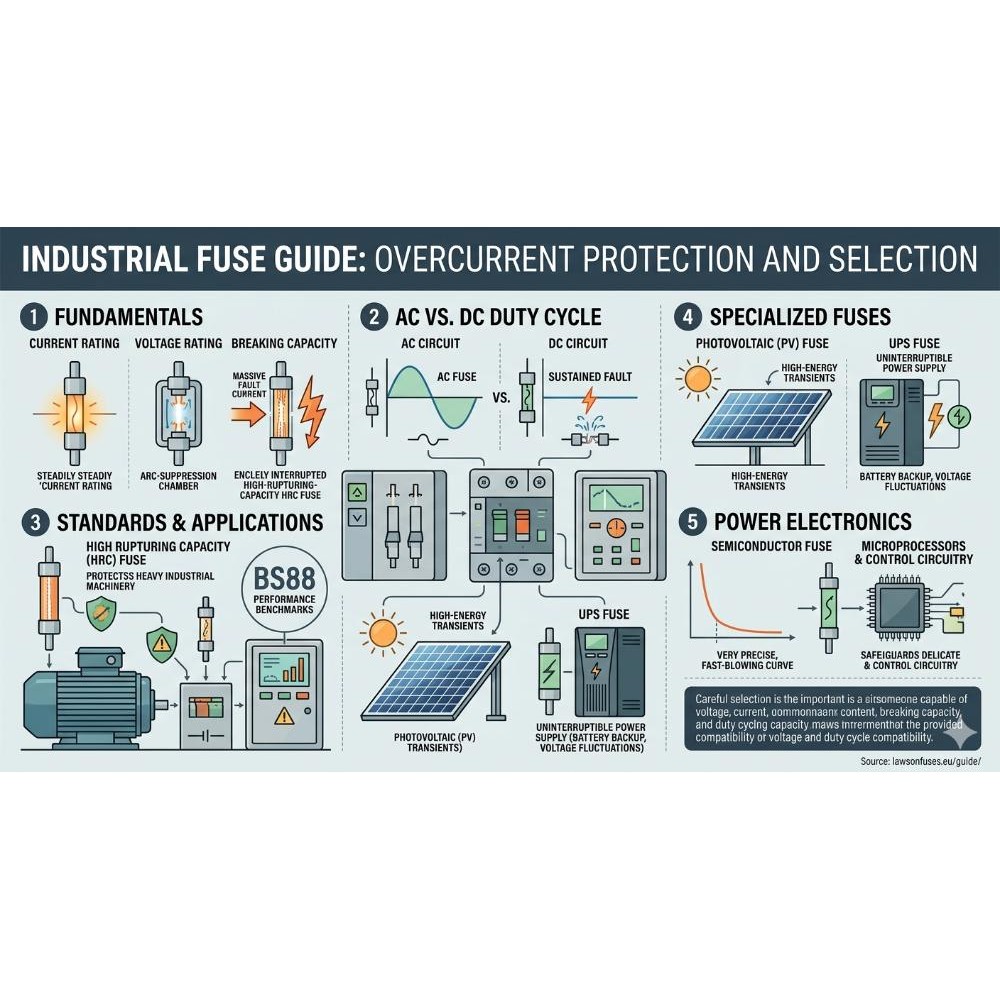
A fundamental consideration when specifying protective devices is the requisite current rating. This rating dictates the continuous operational current the fuse is designed to carry without premature nuisance tripping. Simultaneously, the voltage rating establishes the maximum system voltage the fuse can safely interrupt. Furthermore, engineers must account for the breaking capacity, which is perhaps the most critical metric. This capacity quantifies the maximum fault current the fuse can safely interrupt without sustaining damage to itself or the associated wiring. A fuse rated for insufficient breaking capacity during a severe fault can fail catastrophically, thereby failing to fulfill its primary protective function.
Beyond these primary ratings, the nature of the electrical service—whether Alternating Current (AC) or Direct Current (DC)—imposes significant selection criteria. AC circuits are governed by sinusoidal waveforms, while DC circuits feature constant or variable DC levels. The fuse must be inherently suited to the duty cycle; employing an AC fuse in a pure DC application, for instance, can lead to unpredictable or inadequate protection.
The industry employs several standardized fuse types to address varied fault scenarios. The High Rupturing Capacity (HRC) fuse is perhaps the most recognized standard for industrial applications, designed specifically to manage the massive thermal and mechanical stresses associated with high-fault-current interruptions, making it vital for main circuit protection in industrial machinery. Other standards, such as BS88, define specific performance benchmarks crucial for ensuring compliance and safety across different geographical and industrial sectors.
The growing sophistication of power sources at industrial fuse guide necessitates specialized fuse considerations. For instance, the management of photovoltaic (PV) arrays requires fuses capable of handling the unique, high-energy transients generated by solar conversion. Similarly, Uninterruptible Power Supplies (UPS) demand fuses that maintain integrity across rapid load switching and voltage fluctuations inherent to battery backup systems.
In the realm of power electronics, the selection process must account for the specific component being protected. Semiconductor fuses are engineered for applications where solid-state components are at risk. These fuses offer precise, repeatable interruption characteristics tailored to protect sensitive microprocessors and control circuitry, differing significantly from the bulk protection offered by traditional fuses.
Furthermore, the distinct requirements of DC systems necessitate specialized fuses designed to manage the characteristics of non-sinusoidal, sustained fault currents. These DC fuses must exhibit superior arc quenching capabilities under constant current conditions, a scenario where AC fuses may perform sub-optimally.
Given the confluence of these variables—AC/DC duty, varying fault types, and the need to protect everything from large industrial motors to delicate semiconductors—the complexity of selection can be substantial. Understanding the nuances between these protective mechanisms requires consulting detailed technical documentation; for a comprehensive overview of the technologies involved, reviewing an industrial fuse guide is highly recommended.
In summation, the proper selection of an industrial fuse is not a singular decision but rather an integrated engineering process. It mandates that the chosen device possesses not only the correct nominal current and voltage ratings but also the requisite breaking capacity, the appropriate duty cycle compatibility, and the specific resilience needed for the unique electrical profile of the equipment it safeguards. Adherence to established standards and a thorough understanding of application-specific challenges are paramount to guaranteeing long-term operational reliability and, most importantly, ensuring personnel safety within the electrical infrastructure.